

What does it look like when girls are at the heart of efforts to end FGM? How can communities, local organisations, and institutions come together to support them? These were the questions explored in a recent learning webinar hosted by The Girl Generation-ALM and Africa Population Health and Research Center (APHRC). Participants from across the movement, including partners, funders, and country teams, gathered to hear emerging evidence from “Proof of Concept” assessments in Somaliland, Senegal, and Ethiopia. This follows a similar webinar last year that focused on Kenya.
By reviewing monitoring, evaluation, and learning data from implementation, Proof of Concepts seek to test whether interventions are effective, desirable and if they adhere to safeguarding procedures.
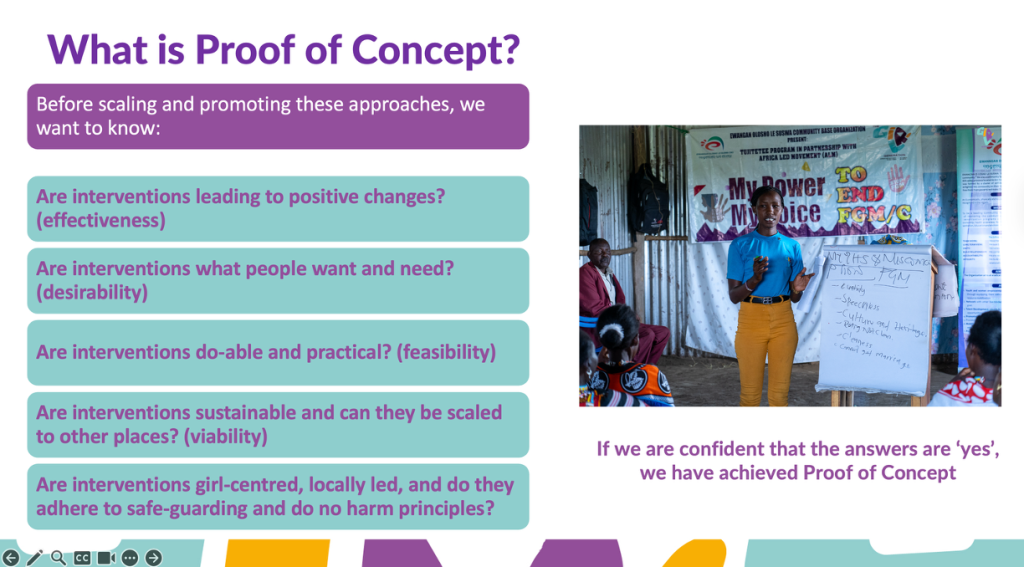
The webinar explored whether locally-led, girl-centred approaches can shift attitudes, build confidence in girls, and create lasting change. It was a chance to move beyond theory and examine what is actually working on the ground.
Why Girl-Centred Approaches Matter
Traditionally, programmes to end FGM focused on communities or laws alone. The Proof of Concept assessments aimed to understand what happens when girls themselves are central to the work. Could they be supported to speak up, influence adults, and drive change in their own communities? Could local organisations lead interventions in ways that are sustainable and sensitive to context?
The results showed that change is possible when girls, communities, and local leaders work together.
Some patterns stood out across all three countries:
- Girls finding their voice: Whether through school clubs or community spaces, girls became more confident and vocal about their rights.
- Dialogue that breaks the silence: Intergenerational, mixed-gender, and single-gender conversations helped challenge stigma and open discussion about FGM.
- Influential adults make a difference: Religious leaders, health workers, and teachers played key roles in supporting or challenging harmful norms.
- Local organisations leading the way: Strengthening capacity allowed communities to own and drive programmes, increasing sustainability.
- Media amplifying impact: Journalist training helped ensure accurate, safe, and local perspectives reached wider audiences.

Each country brought its own lessons:
- In Ethiopia, community health workers engaged parents during antenatal visits to influence decisions around FGM even before birth. This is because in Ethiopia, girls are barely 10 days are subjected to FGM.
- In Somaliland, a “harm reduction” approach reflected the complex interplay of policy, religious interpretation, and community norms.
- In Senegal, “Badineau Gox” champions emerged as powerful voices for change, demonstrating the potential of local advocacy.
These differences underscored an important truth: while strategies can share common elements, they must always adapt to local realities.
The assessments also revealed that girl-centred work is not without complexity. Balancing adult support with girls’ own leadership, shifting attitudes faster than deeply held beliefs, and navigating conflict or insecurity were ongoing challenges. In some contexts, contradictory messages from religious authorities added another layer of difficulty.
But each challenge highlighted where reflection, dialogue, and adaptation are essential.
From Evidence to Action
One of the most valuable outcomes of the PoC assessments is a suite of practical resources that capture lessons and guide implementation:
- Manuals and curricula for girl-centred programming
- Guidelines for engaging safely and respectfully with survivors
- Summaries of PoC findings with recommendations for scaling and adaptation
These resources make it possible for others in the movement to learn from the experiences and adapt them to their own communities.
The webinar made one thing clear: girl-centred approaches are not just an idea — they are showing real impact. When girls are supported, when communities listen, and when local organisations lead, norms can shift.
The work is far from over, but the lessons from Somaliland, Senegal, and Ethiopia provide a roadmap for how the movement can grow stronger, more inclusive, and more effective. By centring girls, we are not only helping to end FGM we are shaping a generation that knows its voice matters.
To learn more about the Proof of Concepts Assessments in the different countries, follow these links:
Proof of Concept in Senegal


