The Commission on the Status of Women continues to serve as a critical global platform for advancing gender equality and amplifying the voices of those driving change. Held at the United Nations Headquarters, the convening brings together governments, civil society, and development partners to shape global conversations and action.
At CSW70, The Girl Generation – Support to the Africa-Led Movement to End FGM (TGG-ALM) partnered with UNJP, Sahiyo, FIGO, and the Global Platform for Action to End FGM to contribute to key discussions on ending FGM.
Through a series of events, including conversations on dismantling racism, strengthening legal frameworks, and sharing evidence on what works, TGG-ALM helped shape dialogue around more effective and inclusive approaches to ending FGM. A central message across all engagements was clear; FGM is not culture, it is a violation of the human rights of women and girls.
FGM Laws and Human Rights Principles: Ensuring Access to Justice for All Women and Girls
“Ending FGM is not only about changing harmful social norms, but it is fundamentally about justice, rights, accountability, and the protection of women and girls. It violates the rights of the child and undermines the promise of gender equality that the global community has committed to uphold.” Said Jacinta Muteshi-Strachan, The Team Lead for The Girl Generation-ALM, during a high-level convening.

This high-level convening was in partnership with UNJP and the Governments of Italy, Sweden, Burkina Faso and Canada, and brought together governments, survivor advocates, civil society, and global partners to examine how legal and human rights frameworks can more effectively deliver justice for women and girls affected by FGM.
The discussions made clear that while progress has been made in establishing legal protections, gaps remain in implementation and accountability. Justice must move beyond legislation to become a lived reality and be grounded in the experiences of those most affected.
“Burkina Faso, in its capacity as a model of legal and judicial resilience in the movement against FGM, continues to highlight the need to maintain an effective watch to complement the law and its procedures.” Said Aminata Ouattara, Permanent Representative of Burkina Faso to the United Nations.
Fatu Baldeh, an FGM survivor and founder of Women in Liberation and Leadership, sheds light on the stark reality in her home country by noting that “…FGM remains deeply rooted in the Gambia. Today, we continue to face a painful contradiction. Despite a legal ban, girls, including infants, are still being cut.” For Baldeh, the solution requires more than just legislative action; it demands a fundamental shift in societal values. She powerfully concludes that “Justice is really addressing the inequalities that allow a harmful practice to be valued more highly than a girl’s bodily autonomy, her dignity, or her life.”
The discussions also highlighted the deliberate inclusion and elevation of survivor voices in decision-making spaces, for justice to become attainable. Fozzia Aden, an FGM survivor and attorney in the USA, reinforced this point by sharing her lived experience and legal perspective. She stressed that centering survivors is not optional but vital for creating truly responsive systems.
“When survivors speak, silence begins to lose its power. Justice is not measured only by the strength of our laws. It is measured by whether the most vulnerable girls are actually protected.” Stated Fozzia Aden.
What Works to End FGM/C? Evidence and Learning from an Africa-Led Movement

Complementing the focus on justice, TGG-ALMs parallel event centered on evidence and learning from the four countries of implementation. This session highlighted practical, proven approaches driving progress toward ending FGM. Key insights from the event reaffirmed that community-driven and context-specific interventions are essential for sustainable change.
In the sub-session on Rethinking Grant-Making and Survivor Leadership to Strengthen Frontline Movements to End FGM, the discussion shifted to the practical realities faced by grassroots actors, especially survivors of FGM and all forms of GBV, and the pressing need to redesign funding models to better support them.
“Funding women-led and community-based organisations is often considered risky. But what if the bigger risk is actually NOT funding them? In our experience, these assumptions can be challenged. By using flexible approaches like phased funding, small and medium grant mechanisms, and intentional capacity building, we’ve seen how trust-based support enables organizations to grow, make an impact, and lead change within their communities,” said Calleb Okoyo, The Grants Lead.
Calleb also noted that sustainability continues to be a critical concern, especially as many frontline organizations struggle to maintain momentum beyond the lifecycle of funded programmes.
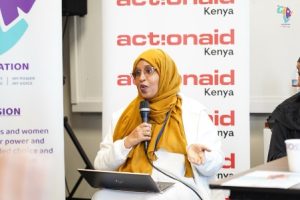
Aisha, a survivor and a grantee partner from Kenya, said, “Many survivor- and women-led organisations start with voluntary labor and deep commitment to change. I registered my organisation in 2018 and worked at the grassroots for years without funding. When TGG-ALM supported us in 2024, it reinforced a powerful truth: resources are not just financial; they create safety, legitimacy, and space for survivors to lead and advocate for change.”
Cate Tito, a survivor and grantee partner in Kenya, shared a heartfelt perspective from her work in Narok. She highlighted that involving survivors in program work is not just about inclusion, but about seeing them as leaders whose lived experiences lend authenticity to efforts to end FGM. She also stressed that this involvement must be supported by careful attention to survivors’ emotional well-being, recognising the emotional toll of sharing personal stories in spaces that can reopen trauma. As she reflected, “We survivors share a lived experience, and providing a platform for others involves sharing the same space with those most affected.”
While discussing Integrating `FGM into Health Systems, the discussion underscored the critical role of healthcare as both a frontline defense and a pathway to holistic, survivor-centered care. Dr Aparna Sridhar from FIGO emphasised the unique position of health professionals as trusted entry points for women and girls, highlighting their responsibility for prevention, identification, and care. As she noted, “OBGYNs and midwives are often the first point of contact for women seeking care, whether for family planning, pregnancy, or childbirth. This makes it essential for health professionals to understand how to recognise and support survivors of FGM, so their physical and emotional needs are met with dignity and compassion.”
Building on this, Prof Samuel Kimani reinforced the need for a comprehensive, system-wide response that goes beyond treatment to include prevention and rehabilitation, while firmly rejecting the medicalization of FGM. He stressed that, “health systems must respond in a three sixty degrees from prevention to treatment to rehabilitation, but most importantly, we must ensure that healthcare workers advance human rights for women and not participate in medicalised FGM.”
Dismantling Racism in Anti-FGM Movements: Towards Survivor-Led, Decolonial Advocacy
In partnership with Sahiyo, a U.S.-based organisation dedicated to ending FGM, we contributed to an important discussion on dismantling racism within the anti-FGM movement. This session provided a space to explore how global narratives, racial hierarchies, and historical power dynamics continue to influence advocacy and responses.
Dr Leyla Hussein, the Global Advocacy Director for TGG-ALM, delivered a powerful critique of the double standards that continue to undermine solidarity and skew advocacy efforts, especially along racial lines. She highlighted the unequal portrayal of FGM, where similar issues are judged differently depending on whose bodies are involved.
Using the example of Labiaplasty versus FGM, both involve the same issue: partial or total removal of the labia minora (inner lips) or labia majora (outer lips) of the vulva, but justifications used are different, making it hard to ignore racism in the context of female sexuality.
Dr. Leyla Hussein stated: “It is hypocritical that because of our skin colour, one is being called barbaric while the other is framed as a choice. We need a shared value where we tell little girls that their genitalia does not need to be changed for anything or anybody. We cannot keep going back to the World Health Organisation framing.”
Mariya Taher of Sahiyo said, ” This conversation on reframing the narrative to end FGM challenged us to examine how power and narratives shape the movement and look at:
1. Who is recognised as an “expert” and who is positioned as a “beneficiary”?
2. Whose pain is amplified, and whose experiences are questioned or dismissed?
3. Who controls funding, narratives, and access to decision-making spaces?
Centered on survivor-led perspectives, the conversation called for a reimagining of the movement, grounded in equity and an anti-colonial approach. Participants reflected on the need to challenge harmful framings and ensure that advocacy is led by those with lived experience.
Our Call to Action
Throughout CSW70 engagments, TGG-ALM maintained its Call to Action, including:
- Centre survivor leadership: Survivors must be at the forefront of the movement and supported with the resources and platforms needed to lead change.
- Use accurate and responsible language: FGM must be clearly recognised as violence against women and girls, not culture.
- Increase investment: Sustainable, flexible funding for grassroots organisations is essential to advancing gender equality.
- Protect women’s rights: Gender equality is fundamental to development, peace, and inclusive governance.
- Strengthen integration: Embedding FGM prevention and response within broader systems and sectors enhances long-term effectiveness.
TGG-ALM’s participation at CSW reinforced the importance of evidence-based advocacy, survivor leadership, grassroots resourcing, and strategic partnerships in advancing efforts to end FGM. The platform provided a valuable opportunity to share knowledge, shape global discourse, and strengthen collaboration among stakeholders committed to gender equality and the rights of women and girls.
A key highlight was the intentional integration of safeguarding and well-being considerations across all discussions, recognising that conversations on FGM can be sensitive and potentially retraumatising for participants. In addition, TGG-ALM showcased audio-visual content on the Model Health Facility, bringing to life the importance of integrating FGM prevention and response within health systems. The video was well received by delegates and contributed to deepening understanding of practical, system-based solutions.