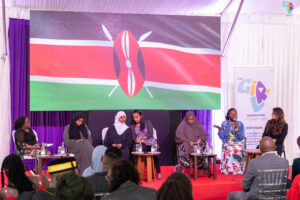
There are moments in a movement when scattered efforts crystallise into something lasting. What happened in Tambacounda between 14 and 16 April 2026 was one of those moments.
Representatives of the four regional coalitions working to end female genital mutilation in Tambacounda, Kédougou, Kolda and Sédhiou, the areas historically recording the highest prevalence rates of FGM in Senegal came together for a three-day workshop on knowledge sharing and capacity building. Brought together with technical support from TGG-ALM together with consortium partners ActionAid Senegal and Amref Health Africa, and in close collaboration with FENOPAME (the national civil society federation for the promotion of the abandonment of FGM), the gathering had a clear ambition: to strengthen the four coalitions and deepen the synergies between them, particularly across borders.
By the end of the third day, the four coalitions had done something significant. They signed an Interregional Pact to Accelerate the Elimination of FGM. A formal, legally grounded alliance committing the regions to harmonise their approaches, pool their resources, and coordinate their advocacy across health, education, law enforcement, survivor support and cross-border surveillance.
Why this pact, and why now?
The southern and south-eastern regions of Senegal sit at the heart of one of the most persistent challenges in the effort to end FGM: the porous border. When communities straddle the borders of Senegal, Guinea-Bissau, Guinea, The Gambia, Mali and Mauritania, the reach of any single region’s laws and campaigns is inherently limited. Girls can be and are taken across borders for the purpose of mutilation, evading the protections that Senegal’s Law 99-05, enacted in 1999, exists to provide.
At the workshop, the Kolda coalition’s experience offered an instructive model. Kolda had already broken new ground, signing a cross-border cooperation protocol in December 2025 with the regions of Janjanbureh (Gambia) and Bafata (Guinea-Bissau) under the auspices of three governors. This workshop offered the other three coalitions the opportunity to learn from that experience and together, they agreed to build on it.
Building a movement
The workshop was opened by the Regional Director of Family Affairs for Tambacounda, representing both the Ministry of Family Affairs and the Governor. Her opening address set the tone: coordinated action and attention to cross-border dynamics were not optional extras in this effort.
Over three days, participants heard presentations on the legal and contextual framework for ending FGM in Senegal, the TGG-ALM programme’s girl- and survivor-centred approach, the establishment and progress of each regional coalition, and the cross-border cooperation mechanism developed by Kolda, Janjanbureh and Bafata. Discussions were extensive and frank. Challenges were named clearly: weaknesses in coordination at the local level, inconsistent enforcement of existing laws, limited resources, and the practical difficulties of working across porous borders.
Then each regional coalition moved into working groups to develop action plans for the next six months, identifying priorities and strategies for advocacy and resource mobilisation.
The Pact
The Interregional Pact signed at the close of the workshop is not a declaration of intent. It is a structured commitment with seven strategic priorities. Among the most striking of those indicators is what the pact calls “the golden indicator”: the shift from clandestine practice to community reporting. As the pact notes, if the number of reports increases at the outset, this is paradoxically a sign that the work is succeeding that the taboo is being broken, that communities feel safe enough to speak.
The pact was signed in the presence of the Prefect of Tambacounda, representing the Regional Governor, with administrative authorities and technical and financial partners including TGG-ALM as witnesses.
What comes next
The workshop closed with a shared sense of purpose. For FENOPAME, the movement to end FGM is, in the words of its president, “well on track.” For TGG-ALM, the signing of this pact is evidence that the Africa-led movement is not only growing but also organising, coordinating, and holding itself accountable.