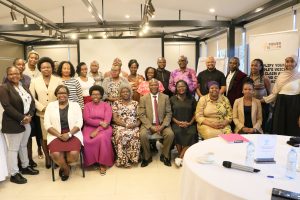
Ending female genital mutilation (FGM) calls for health systems capable of preventing FGM, responding to cases, and supporting survivors. As the world observed the 16 Days of Activism Against Gender-Based Violence 2025, The Girl Generation-ALM, in partnership with Foreign Commonwealth Development Office (FCDO) and World Health Organization (WHO), convened a webinar to share evidence on how health systems play a central role in ending Female Genital Mutilation (FGM).
The one-hour learning webinar was attended by policymakers, health experts, and consortium partners to discuss innovative, locally- led approaches to integrating FGM prevention and response into medical training and healthcare services.
Why is it important?
TGG-ALM, now in its fifth year of implementation, has focused on developing approaches that are locally-led, scalable, and sustainable. Central to this effort is a Health Model Facility in Narok, Kenya, which positions health workers as opinion leaders in FGM prevention, response and care. By guiding healthcare professionals to reflect on their own values, build skills in person-centered communication, and integrate FGM prevention into routine care, the programme aims to create lasting change at the community level.
Professor Samuel Kimani of the Africa Coordinating Center for Abandonment of FGM (ACCAF) and a member of faculty at The University of Nairobi emphasized why this approach must start at the foundation: “Integration needs to happen at the source where we train healthcare workers so the next generation is knowledgeable, skilled, and empowered to undertake prevention and response.” In other words, it’s not enough to have policies in place; health workers themselves must be equipped and confident to act.
A central element of the model is preparing health workers to address FGM comprehensively. Christina Pulito from WHO explained, “Value clarification is critical, we unpack beliefs around traditions and rights, and make sure women and girls don’t experience any harm.”
This training approach recognizes that health workers are at different points along the spectrum from those performing medicalized FGM to those already advocating against it and tailors support accordingly. By addressing beliefs, skills, and attitudes simultaneously, we strengthen the frontline workforce while fostering lasting change.
Holistic, Person-Centered Care
In Narok, Kenya, ACCAF has established a Model Health Facility that goes beyond standalone FGM services. “Handling survivors of FGM as a standalone service fuels stigma and barriers. We address women’s physical, emotional, and psychological needs, which builds trust and enables them to discuss FGM openly,” Hellen Sankaine, a Clinical Support Officer in Narok.
“This facility is unique because FGM prevention and response are an integral part of all care provided at each service delivery point,” said Hellen. By embedding FGM services into routine health care, the facility ensures women feel safe to seek support, reducing stigma and barriers to care.
The results speak for themselves: in some months, the facility has achieved 170% of its targets for women accessing services. By putting the survivor at the center, the approach encourages open dialogue, ensures comprehensive care, and creates pathways for prevention and support.
Evidence, Adaptation, and Sustainability
Integration is not static; it is continuously informed by evidence. Professor Kimani explained, “Every time we implement, we collect evidence and feedback. This allows us to refine our approach, avoid wasting resources, and ensure services are effective.”
Sustainability is further strengthened by embedding programs within existing health structures and empowering local governments. Hellen added, “Empowering local governments allows policies to trickle down to communities, remaining even as political leadership changes.” This ensures that the model can endure and expand, reaching more girls and women over time.
Based on the lessons from Kenya’s Model Health Facility and WHO, the speakers outlined key strategies for integrating FGM prevention into health systems:
- Embed FGM prevention and response across all health services. Integration ensures consistent access for survivors and at-risk girls.
- Train health workers from pre-service through continuous professional development. Equip them with knowledge, skills, and values clarification.
- Take a holistic, person-centered approach. Address physical, mental, and emotional needs to build trust and reduce stigma.
- Collect and use evidence to guide programming. Continuous monitoring and feedback improve service effectiveness.
- Coordinate with communities for culturally sensitive delivery. Engage local leaders and families to strengthen acceptance and sustainability
The webinar reinforced that integrating FGM prevention and care into health systems is a strategic, sustainable, and rights-based approach. Kenya’s Model Health Facility demonstrates that when health systems, communities, and workers collaborate, fewer girls face FGM, and survivors receive the care and protection they deserve.
As Professor Kimani summarized, “This approach ensures that even future generations will be reached through routine health services, and ultimately, fewer girls will be exposed to FGM.”
Resources and Further Learning
- WHO’s facilitator’s guide: Person-centred communication for FGM prevention
- Research on feasibility and scaling: PubMed 33522926 | PubMed 38987991